 SimSmsBox
 Quick answer: A WhatsApp OTP is a one-time verification code delivered inside a WhatsApp chat instead of as a text message. For the user it feels the same — a 6-digit code — but it travels over the internet through a verified business account, so it’s cheaper for the sender and shows a trusted brand name. The catch: it only reaches people who have WhatsApp installed and online, which is why SMS OTP stays the universal fallback.
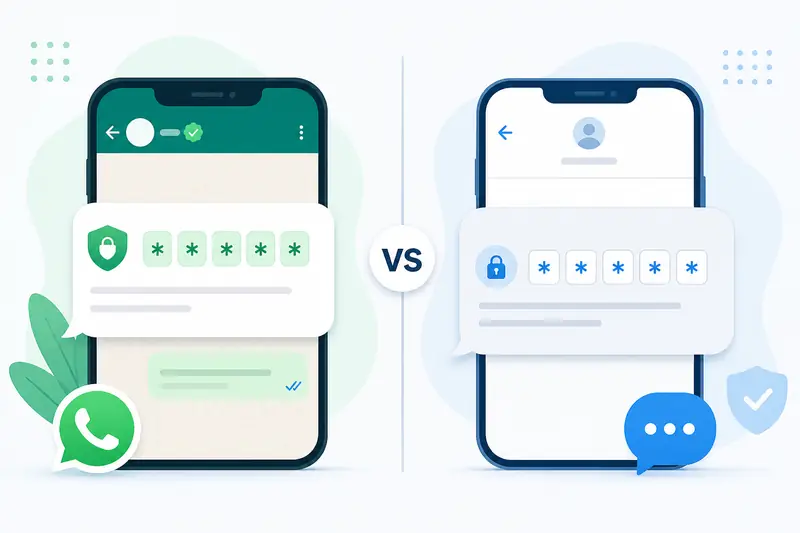
More sign-up flows now say “we’ll send your code on WhatsApp.” It looks like a small change, but WhatsApp OTP and SMS OTP run on completely different rails. Here’s what actually differs and what it means for getting your code.
1. How WhatsApp OTP works
Instead of sending a text through the mobile network, the service uses the WhatsApp Business API to deliver the code as a chat message from a verified business account. The code arrives in your WhatsApp thread with that company, often with the brand’s name and green verified badge. You copy the 6 digits (or tap an autofill button) exactly like an SMS code.
Because it rides over data, delivery doesn’t depend on carrier SMS routes — but it does depend on you having WhatsApp installed, registered, and connected to the internet.
2. WhatsApp OTP vs SMS OTP
| Factor | WhatsApp OTP | SMS OTP |
|---|---|---|
| Transport | Internet (data/Wi-Fi) | Cellular text channel |
| Needs an app | Yes (WhatsApp) | No |
| Needs data connection | Yes | No |
| Sender identity | Verified business name | Number or sender ID |
| Cost to sender | Lower in many regions | Higher per message |
| Universal reach | No | Yes |
The pattern mirrors the RCS vs SMS story: richer, branded, cheaper delivery — but not universal, so SMS remains the backstop.
3. Why services like it
- Cost: WhatsApp conversation pricing is often cheaper than international SMS, which adds up at scale.
- Trust: a verified business badge fights spoofing and smishing better than a random number.
- Reach in specific markets: in regions where WhatsApp is the default messenger, delivery can be more reliable than SMS.
4. What it means for receiving codes
This is where it matters if you use online numbers. A WhatsApp OTP is tied to a WhatsApp account on that number, not just to receiving a text. So:
- An SMS-only online number can’t receive a WhatsApp OTP unless a WhatsApp account is actually registered on it.
- Most services that offer WhatsApp delivery also keep an SMS option — choosing SMS keeps things simple and keeps receiving codes online without a SIM working.
- If a flow is WhatsApp-only, you need a number with a live, verified WhatsApp account, which is a higher bar than plain SMS.
Either way, the code is still a shared secret, so the usual advice applies: never forward it, and treat it like a password, as covered in phone-number privacy habits.
FAQ
Q: Is a WhatsApp OTP more secure than SMS? The verified sender reduces spoofing, but the code itself is the same kind of secret and can still be phished. For real interception resistance, see passkeys vs SMS OTP.
Q: Can I get a WhatsApp code without WhatsApp installed? No. If WhatsApp isn’t installed and registered on the number, the service must fall back to SMS.
Q: Why did my code come by SMS when the app said WhatsApp? Delivery fell back — usually because there was no reachable WhatsApp account, or WhatsApp was offline.
Takeaway
WhatsApp OTP is a cheaper, branded, more trustworthy-looking way to deliver codes over the internet, and it’s growing in WhatsApp-heavy markets. But it only reaches people with an active WhatsApp account online, so SMS OTP remains the universal fallback that works on any phone, on any network.