 SimSmsBox
 Quick answer: Protecting your phone number privacy comes down to “give less, layer, and harden”: don’t hand over your real number when you don’t have to, isolate risk with disposable or secondary numbers, and lock down important accounts with a strong password plus 2FA. That way, even if one platform leaks data, your main number and core accounts aren’t swept up with it.
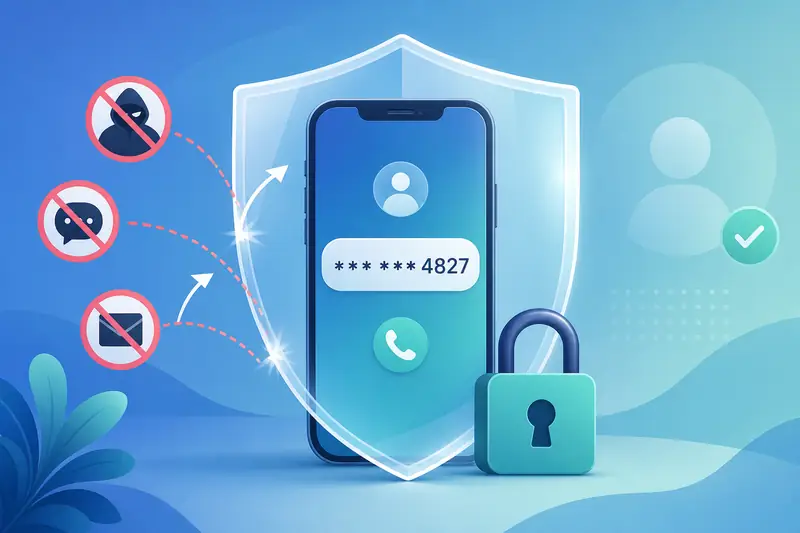
Your phone number stopped being “just for calls” a long time ago. It’s the key to account recovery and the unique ID that links platforms to you. Once it leaks, spam calls, targeted scams, and credential-stuffing follow. The good news: a few simple habits cut the risk dramatically. Here are 7 practical ways.
1. Don’t give your real number when you don’t have to
Many sign-ups don’t truly need your real number. When something only needs to pass one verification, use a disposable phone number or receive SMS online without a SIM. Every real number you hand out is a future potential leak.
2. Layer your accounts: main, secondary, temporary
- Main number: only for your most critical accounts — bank, payments, government — never scattered around;
- Secondary number: a different number for everyday apps, shopping, social;
- Temporary numbers: receive-code numbers for one-off trials, promos, and unfamiliar platforms.
The point of layering: a leak in one layer doesn’t reach your most important layer.
3. Enable 2FA on important accounts
Privacy isn’t only “hiding the number” — it’s making the number hard to exploit even if exposed. Turn on two-factor authentication (2FA) for core accounts, and prefer an authenticator app over SMS-only. This blocks the vast majority of automated takeovers.
4. Watch out for SIM swapping
Attackers can impersonate you at the carrier to re-issue your SIM and hijack your number to receive codes. Key defenses:
- Set a separate password or PIN on your carrier account;
- Avoid SMS-only as the sole 2FA on your most important accounts;
- If your phone suddenly loses signal or stops receiving texts, contact your carrier immediately.
5. Don’t expose your number in public
Social profiles, resumes, group announcements, marketplace listings — posting your number there feeds it to scrapers and spam lists. When contact is needed, prefer email or in-platform messaging. For the trade-offs between the two channels, see SMS vs email verification.
6. Clean up and check regularly
- For apps you no longer use, delete the account or at least unbind your number;
- Periodically search your own number to see if it appears in public breach data;
- Treat an unexpected verification code (one you didn’t request) as a warning — someone may be trying to use your number.
7. Keep the “receive-code” step clean
If you do use an SMS platform, pick a reputable one and toss the number when done; never enter your number or code on a sketchy site. Before you buy, it also helps to understand SMS verification pricing so you’re not lured by suspiciously cheap sources.
FAQ
Q: Does a disposable number make me fully anonymous? Not fully. It isolates your real number, but platforms can still correlate you via IP, device fingerprint, and more. Privacy is “layered risk reduction,” not “total invisibility.”
Q: My number already leaked — can I recover? Yes. Immediately set strong passwords and 2FA on important accounts, review bindings and login history; if spam is severe, consider changing numbers and applying the layering strategy on the new one.
Q: Is email a safer contact channel than a phone number? Email is more flexible for “unlimited signups and easy isolation” — but only if the inbox itself has a strong password plus 2FA.
Takeaway
Protecting your phone number privacy isn’t locking it in a vault — it’s doing three things together: expose less, layer usage, and harden strongly. Keep your real number for your most critical accounts with 2FA on, and hand everyday and one-off scenarios to secondary and temporary numbers. Then, whichever platform gets breached, your core identity stays rock-solid.