 SimSmsBox
 Quick answer: An OTP (One-Time Password) is a dynamic code that works only once. The most familiar form is the 6-digit SMS code you receive when signing up or logging in. Its whole point is this: even if someone knows your password, they can’t get in without this real-time code — which is why OTPs power two-factor authentication (2FA).
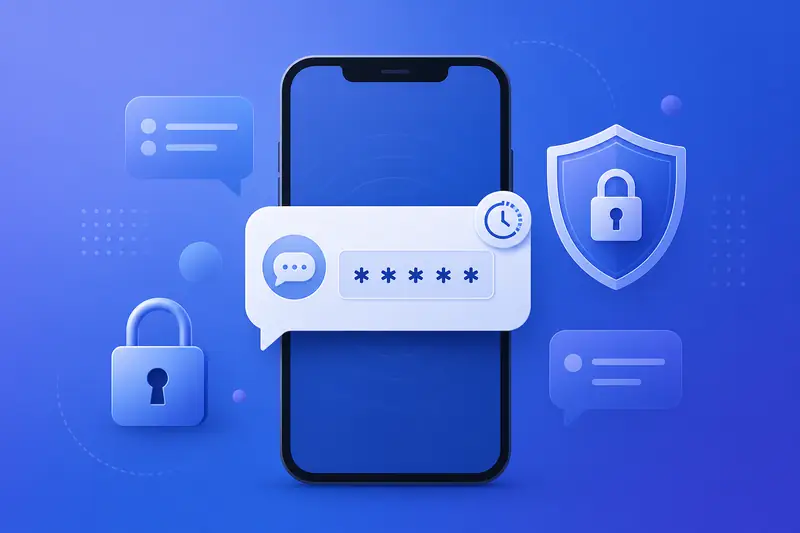
You use OTPs almost every day. That “your code is 123456, valid for 5 minutes” message is a textbook OTP. It looks trivial, but it’s a cornerstone of modern account security. This guide explains what an OTP is, how it works, the main types, and what to do when one doesn’t arrive.
1. What an OTP is
OTP stands for One-Time Password. Unlike your long-lived account password, an OTP has two defining traits:
- Single use: it’s void the moment it’s used and can’t be reused;
- Time-limited: it’s usually valid for only seconds to a few minutes.
Because it’s “use once and throw away,” even if an OTP is glimpsed in transit, an attacker can rarely exploit it within the window. That’s the root of its security.
2. How an OTP works
Take the most common case — an SMS OTP:
- You click “send code” on a website.
- The server generates a random code and records it with an expiry time.
- The server sends the code to your phone number through an SMS gateway.
- You type the received code back into the site.
- The server compares: correct and not expired → pass; otherwise reject.
The whole flow proves that you currently control that phone number, which is exactly why reliably receiving the code matters so much.
3. Common types of OTP
| Type | Channel | Notes |
|---|---|---|
| SMS OTP | Text message | Most common; needs a number that can receive |
| Voice OTP | Phone call | Fallback when SMS fails |
| Email OTP | Often for recovery / secondary checks | |
| TOTP | Authenticator app | Time-based, generated locally, no network |
| Push OTP | App push approval | One-tap approve, smooth UX |
TOTP (time-based one-time passwords), generated locally by apps like Google Authenticator or Authy, resists hijacking better than SMS. For a full comparison, see Real SIM vs virtual numbers.
4. How OTP relates to 2FA
An OTP is the most common “second key” for two-factor authentication (2FA): the first key is the password you know, the second is the one-time code you get right now. Stacked together, they raise account security dramatically. That’s why platforms ask you to verify by SMS at sign-up — it both confirms your number and lays the groundwork for future 2FA.
5. What to do when the OTP doesn’t arrive
A missing SMS OTP is the most common headache. Typical causes and fixes:
- Number type: virtual numbers are often rejected — switch to a real SIM number.
- Wrong country/prefix: make sure the number’s country matches the target service.
- Not waiting long enough: SMS can lag; wait out the countdown before retrying.
- Rate-limited by risk control: frequent requests get throttled — try again later.
If you don’t have a suitable number, you can receive SMS online without a SIM card to catch the OTP temporarily.
FAQ
Q: Is an OTP the same as a “verification code”? In everyday use, basically yes. Strictly, OTP stresses “one-time, dynamically generated,” while “verification code” can also include image CAPTCHAs — but at sign-up, the code you get is usually an OTP.
Q: How long is an OTP valid? Most last 1–10 minutes; SMS OTPs are commonly 5 minutes. After that you must request a new one.
Q: Can OTPs be stolen? In theory (phishing, SIM swapping), but single-use plus expiry greatly reduces the risk. Never share an OTP with anyone — including “support.”
Takeaway
An OTP is a dynamic, use-once password and the backbone of modern account security and 2FA. Understand it and you’ll see why sign-ups keep asking for SMS codes — and where to look (number, country, timing, rate limits) when one won’t arrive. The single most important rule: anyone asking you for your OTP is running a scam.