 SimSmsBox
 Quick answer: A voice OTP is a one-time code delivered by phone call and read aloud by an automated voice, instead of by text. When SMS is filtered, running late, or a number simply can’t receive texts, the call is the fallback — you answer, hear “your code is…,” and type it in.
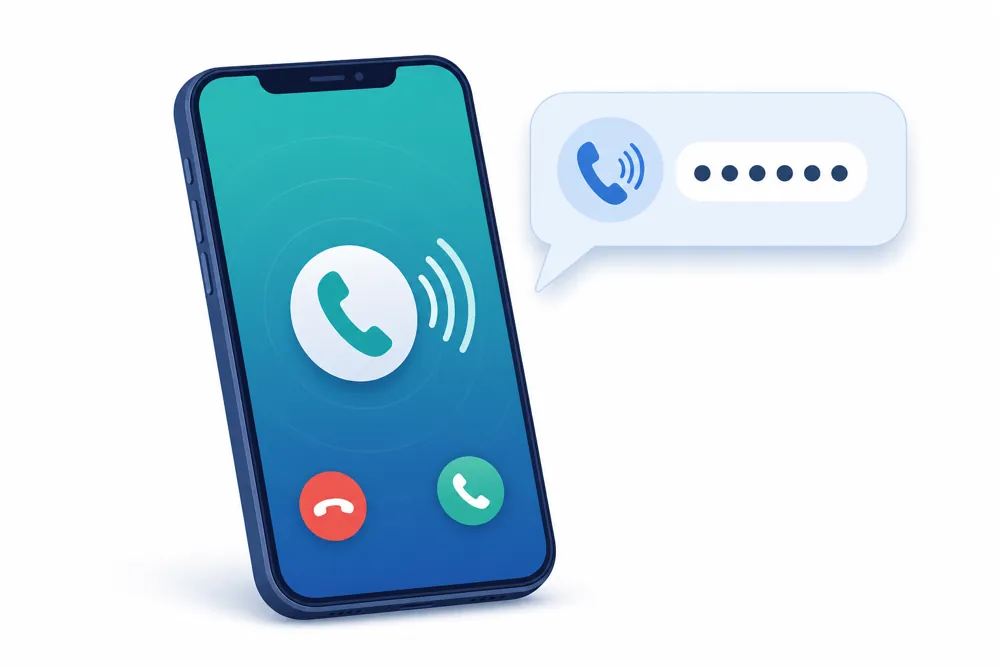
You tap “call me with the code,” and a few seconds later your phone rings. A calm robotic voice reads out six digits, usually twice so you can catch them. A voice OTP travels over the voice network rather than the messaging network — and that small difference is exactly why it sometimes works when SMS stalls.
1. How a voice OTP works
Instead of packing the code into a text, the sender (a bank, an app, or a verification service) places an automated outbound call. When you pick up, a text-to-speech engine reads the code out digit by digit, normally repeating it. The path is app → voice provider → phone network → your number.
The key point: it uses the voice channel, a separate delivery path from SMS. So the problems that hit texts — carrier anti-spam filtering, A2P congestion, cross-border grey routes — don’t necessarily affect a phone call.
2. When it gets used
- SMS keeps failing. Many platforms offer “call me instead” as an automatic fallback after a couple of retries.
- Landlines and some business numbers. These often can’t receive texts, so a call is the only way through — see can a landline receive SMS.
- Accessibility. For users with low vision, hearing a code is easier than reading one.
- High-value actions. Some risk engines prefer voice for large transfers to reduce the odds of an intercepted text.
3. Voice OTP vs SMS OTP
| Dimension | Voice OTP | SMS OTP |
|---|---|---|
| Delivery channel | Voice network | Messaging network |
| Common delay cause | Busy line, no answer | Filtering, congestion, routing |
| Works on landlines | Yes | Usually no |
| How you capture it | Listen, maybe replay | Copy or autofill |
| Intrusiveness | Higher (it rings) | Lower |
SMS is faster and easier to handle, which is why it stays the default. Voice earns its keep as an independent second path for when texts don’t get through.
4. It’s not the same as a flash call
Don’t confuse a voice OTP with flash call verification. A flash call is a missed call that hangs up almost instantly, with the code hidden in the last digits of the calling number — you never answer. A voice OTP asks you to answer and listen to the code read aloud. Both use the voice network, but flash calls are lighter and better for automatic detection, while voice is more universal and better for accessibility.
5. Security: can a voice OTP be abused?
A code itself isn’t “more” or “less” secure — the real risk is who you hand it to. Scammers call pretending to be your bank, manufacture urgency, and coax you into reading back the code you just received. That’s vishing (voice phishing).
Hold one rule firmly: a legitimate company will never call to ask for your verification code. A code is something you type into the official page, not something you recite to a caller. Anyone on the phone asking for your code is a scammer.
6. What to do if the voice code doesn’t come
- Confirm the number can take calls and isn’t blocking or set to do-not-disturb.
- Don’t keep resending. Rapid requests trip rate limits that slow things down.
- Answer somewhere quiet and let it repeat the code if needed.
- International numbers may lag due to route quality — the same reason SMS delivery depends on the path.
FAQ
Q: Is a voice OTP safer than SMS? No. Safety depends on whether you share the code, not on how it’s delivered. Both are one-time passcodes.
Q: Why does it read the code twice? Six digits are easy to mishear once, so repeating gives you time to catch them all. It’s part of why codes are usually 6 digits — short enough to hear and type, still hard to guess.
Q: Can I get a voice code on a landline? Yes, and that’s a major advantage of the voice channel — landlines can’t receive SMS but can take calls.
Takeaway
A voice OTP reads a one-time code to you over a phone call, using a different channel than SMS. It’s a reliable fallback when texts are filtered, slow, or unsupported — but it’s still a one-time passcode: only ever enter it on the official page, never read it aloud to a caller.