 SimSmsBox
Quick answer: A real SIM number is issued by a mobile carrier and lives in a physical SIM, so target apps read it as an ordinary person’s number — high delivery rates, few rejections, and it stays usable for days rather than one code. A virtual number is generated over VoIP: cheap and instant, but its ranges are published, heavily reused, and increasingly blocked. Use real SIM for anything important or strictly policed (Telegram, finance, AI tools); save virtual numbers for one-off, low-risk signups.
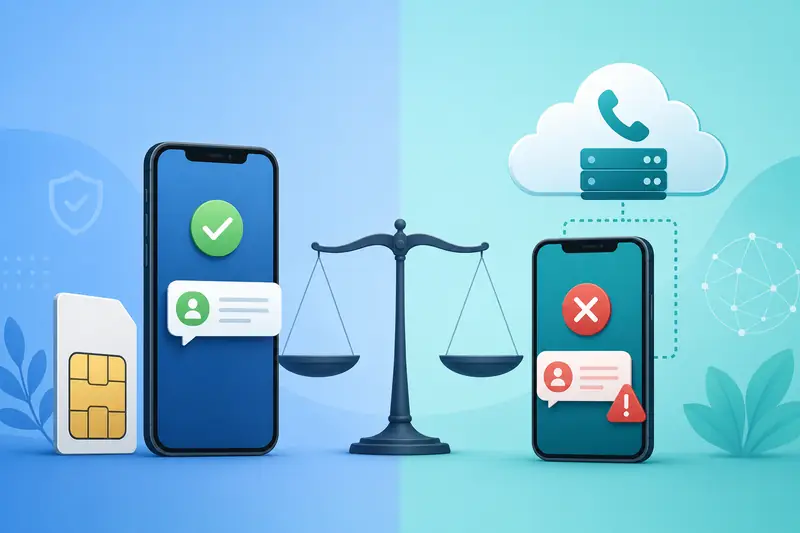
A lot of people pick an SMS service on price alone, then the number gets flagged halfway through signup and the code never arrives. The problem usually isn’t the platform — it’s where the number comes from: a real carrier SIM, or a chunk of network-generated virtual numbers.
The difference in one line
A real SIM number comes from a physical carrier SIM in a real device, so its range, ownership and behavior look like an ordinary user. A virtual number is mostly mass-generated by a VoIP service, its range is public and easy for target platforms to spot. Sending the same Telegram or Google signup, a real SIM clears verification noticeably more often.
Why virtual numbers get banned
A target platform’s risk control isn’t mysterious — it mainly reads a few signals:
- Range origin: many VoIP ranges are tagged “virtual / non-fixed VoIP” in public databases, so one lookup gives it away.
- Reuse density: a single virtual number reused by hundreds of people already has a dirty behavior profile.
- Throwaway pattern: a number that grabs one code and never appears again is easy to trace back and ban.
Telegram, WhatsApp, Google and most financial and AI services keep their own lists of known VoIP ranges. When your number lands in one, you’ll usually see one of three outcomes:
- an immediate “this number can’t be used for verification”;
- an SMS that the interface claims to have sent but that never arrives;
- registration that appears to succeed, followed by a ban a few days later as “suspicious”.
That last one is why “code received but verification fails” and “registered fine, banned within the week” are such common complaints — both usually trace back to the number, not the platform.
Where real SIM SMS wins
A real SIM number sits on a genuine SIM, with normal signaling and ownership on the carrier network, so the platform has no clear “this is an SMS-receiving number” evidence. SimSmsBox’s real SIM adds two concrete perks:
- Validity of 1–30 days, reusable within the window: not retired after one code, so re-verification and password recovery can reuse the same number.
- Higher success rate: because the range is clean and behaves more like a real person, fewer signups get blocked.
Real SIM vs virtual: one table
| Dimension | Real SIM (SimSmsBox) | Virtual / VoIP SMS |
|---|---|---|
| Range origin | Genuine carrier SIM | Mass-generated, public ranges |
| Risk-control detection | Hard | Easy (often flagged VoIP) |
| Signup success rate | High | Volatile; popular apps often reject |
| Service coverage | Wide | Narrow; many apps refuse it outright |
| Validity | 1–30 days, reusable | Mostly single-use |
| Stability | Stable | A blocked range dies in bulk |
| Unit price | Slightly higher | Low |
| Best for | Long-term accounts, strict platforms | Low-risk, one-off verification |
When a virtual number is actually the smarter buy
Not every case needs a real SIM. If you’re just doing a one-off signup on a low-risk small site and the account isn’t meant to last, a virtual number’s low price saves money. The rule of thumb is simple: is this account worth paying a bit more to “not get banned”? For long-term use, or to clear strict platforms like Telegram/Google/OpenAI, don’t cut corners on the number.
By scenario:
- Important, long-term accounts — real SIM, ideally a number you keep control of. Don’t cut corners here.
- Strict services (Telegram, finance, AI) — real SIM, and keep your IP in the same country as the number.
- One-off, low-risk signups — a virtual number is fine and cheaper. Use it and discard it.
- Cross-border e-commerce or bulk accounts — go hybrid: real SIM for the core accounts, virtual for peripheral ones to hold costs down.
How to tell which one you’re being sold
- Check the label. Reliable platforms separate “real SIM / physical” from “virtual” and price them differently. A vendor that won’t say which one you’re getting is telling you something.
- Check the price. Suspiciously cheap numbers with apparently unlimited supply are virtual, whatever the listing says.
- Test it small. Spend the minimum and run one real verification against your actual target service. If the code lands and the account survives, the source is genuine. For the wider evaluation checklist, see what an OTP code is and how delivery works.
What a real SIM code run looks like
Using the SimSmsBox API, ordering and reading the code is two steps:
# 1) Order a real SIM number for Telegram (cardKind=physical means real SIM)
curl -X POST https://api.simsmsbox.com/api/sms/orders/purchase \
  -H "X-API-Key: psk_xxx" \
  -H "Content-Type: application/json" \
  -d '{"service":"telegram","country":"US","cardKind":"physical","rentDays":30}'
# -> { "orderId": 19, "phone": "+1xxxxxxxxxx", ... }

# 2) Query the order for the code (reusable within the validity window); {id} = orderId
curl https://api.simsmsbox.com/api/sms/orders/19 \
  -H "X-API-Key: psk_xxx"
# -> { "status": "...", "latestCode": "493021", "expireAt": "..." }
For polling cadence and retry strategy, see Automated ordering and polling to avoid empty polling that burns balance.
FAQ
Q: Are virtual numbers completely useless? No. For low-risk, one-off signups they work fine and cost less. Just don’t put a Telegram, banking or AI account behind one.
Q: Do real SIM numbers always succeed? High success, but not 100%. You still need the right country, an IP that matches it, and enough patience for the SMS to land.
Q: Why does one number work on an app while another doesn’t? Almost always the number’s source: a clean real-SIM pool versus a flagged virtual range. Switching to a real SIM fixes most of these cases.
Wrap-up
For the long haul or strict platforms, go real SIM; for one-off, low-risk signups, virtual is cheaper. Decide the account’s value first, then decide how much to spend on the number. Further reading: How to choose an SMS platform helps you weigh price, stock and stability together.